Reverse Osmosis vs UV Water Purification Technologies: What’s the Difference?
TL;DR Short Answer:
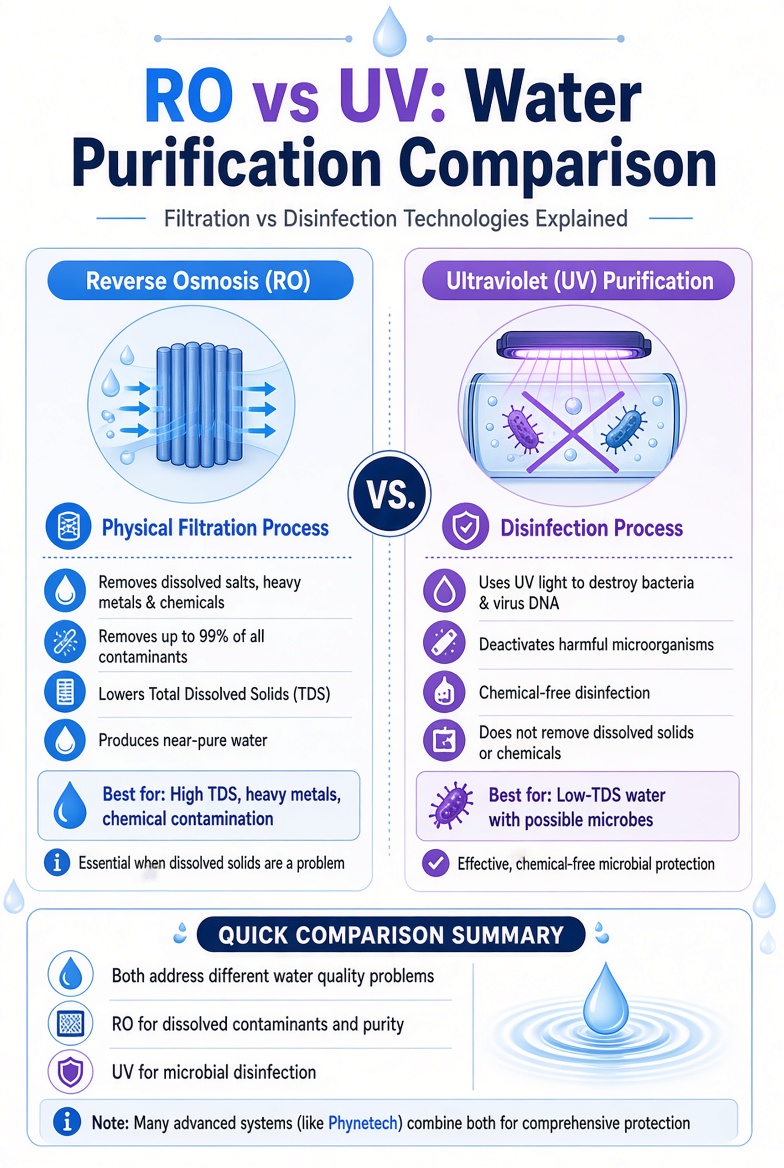
Reverse osmosis (RO) and ultraviolet (UV) purification are fundamentally different technologies that address distinct water quality problems. RO is a filtration process that physically removes dissolved salts, heavy metals, and up to 99% of all contaminants by forcing water through a semi-permeable membrane. UV purification is a disinfection process that uses ultraviolet light to deactivate bacteria and viruses by destroying their DNA, but it does not remove dissolved solids or chemical contaminants.
If your water has high Total Dissolved Solids (TDS), heavy metals, or chemical contamination, RO is essential. If your water is already low in dissolved solids but may contain harmful microorganisms, UV is an effective, chemical-free solution. For comprehensive protection, many systems now combine both technologies. This how Phynetech advanced water purification machines are made.
Introduction
When researching water purification technology, two terms appear repeatedly: Reverse Osmosis (RO) and Ultraviolet (UV). Both are effective water treatment technologies, but they work in completely different ways and solve different problems.
Choosing between them—or deciding to use both—requires understanding what each technology does, what it removes, and what it leaves behind. This guide explains the key differences between reverse osmosis vs UV water purification in simple, practical terms, helping you determine which technology—or combination—is right for your specific water quality needs in Kenya.
Reverse Osmosis vs UV Water Purification
What Is Ultraviolet (UV) Water Purification?
Ultraviolet (UV) water purification is a disinfection method that uses ultraviolet light to kill or inactivate harmful microorganisms.
How UV Works
UV systems pass water through a chamber containing a UV lamp. The lamp emits ultraviolet light at a specific wavelength (254 nanometers) that penetrates the cells of bacteria, viruses, and other pathogens, destroying their DNA and preventing them from reproducing. Once their DNA is damaged, these microorganisms cannot cause illness, even though they remain physically present in the water.
What UV Removes
- Bacteria (E. coli, Salmonella, and others)
- Viruses (Hepatitis, Rotavirus)
- Protozoa (Cryptosporidium, Giardia)
What UV Does NOT Remove
- Dissolved salts and minerals
- Heavy metals (lead, mercury, arsenic)
- Total Dissolved Solids (TDS)
- Chemical contaminants
- Sediment or suspended particles
Advantages of UV
| Advantage | Explanation |
| Chemical-free | No chemicals are added to the water |
| Preserves taste and odor | Does not alter water’s natural characteristics |
| Effective against microorganisms | Destroys a wide range of pathogens |
| Relatively low cost | More affordable than RO systems |
| Easy to maintain | Simple operation with minimal maintenance |
| Energy-efficient | Uses less electricity than RO |
| No water wastage | Unlike RO, UV does not produce a concentrate stream |
Disadvantages of UV
| Disadvantage | Explanation |
| Does not remove dissolved solids | Cannot reduce TDS, salts, or heavy metals |
| Requires clear water | Turbid or muddy water blocks UV light, reducing effectiveness |
| Needs electricity | Requires a continuous power supply |
| No residual protection | Does not protect against recontamination after treatment |
| Dead pathogens remain | Killed bacteria remain suspended in the water |
What Is Reverse Osmosis (RO) Water Purification?
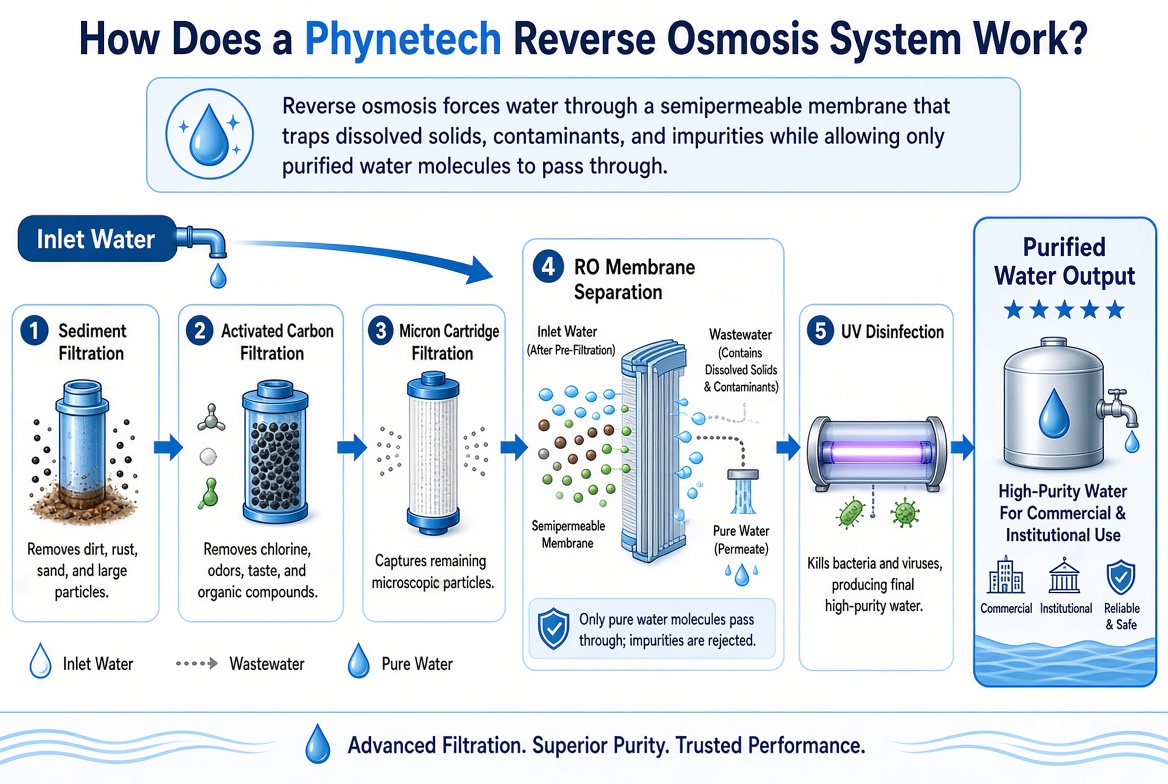 Reverse osmosis is a filtration process that removes contaminants at the molecular level by forcing water through a semi-permeable membrane.
How RO Works
RO systems use high pressure to push water through a membrane with pores so tiny they are measured in angstroms—smaller than a billionth of a meter. Only water molecules can pass through; dissolved salts, heavy metals, and other contaminants are trapped and flushed away in a concentrate (waste) stream.
What RO Removes
- Dissolved salts and minerals
- Heavy metals (lead, mercury, arsenic)
- Up to 99% of all contaminants
- Bacteria and viruses
- Chemical contaminants (pesticides, industrial pollutants)
- Total Dissolved Solids (TDS)
What RO Does NOT Remove (Effectively)
- Some dissolved gases
- Certain volatile organic compounds (without adequate carbon pre-treatment)
Advantages of RO
| Advantage | Explanation |
| Comprehensive removal | Removes up to 99% of all contaminants |
| Removes dissolved solids | Reduces TDS, salts, and heavy metals |
| Removes chemical contaminants | Effective against pesticides and industrial pollutants |
| Produces highly pure water | Ideal for drinking, bottling, and sensitive applications |
| Removes dead pathogens | Filters out the bodies of killed bacteria |
| Works with turbid water | Built-in pre-filtration handles sediment |
| KEBS-compliant for bottling | Can achieve TDS below 10 mg/L required for bottled water |
Disadvantages of RO
| Disadvantage | Explanation |
| High energy consumption | Requires significant electricity for high-pressure pumps |
| Water wastage | 20–50% of feed water is discharged as concentrate |
| Higher cost | More expensive to purchase and maintain |
| Requires pre-treatment | Membranes are sensitive to fouling |
| Removes beneficial minerals | Strips water of calcium and magnesium |
| Complex maintenance | Requires regular filter and membrane changes |
| Higher operating costs | Ongoing costs for filters, chemicals, and electricity |
Key Differences Between UV Water Purification Technology Vs Reverse Osmosis Water Purification Technology
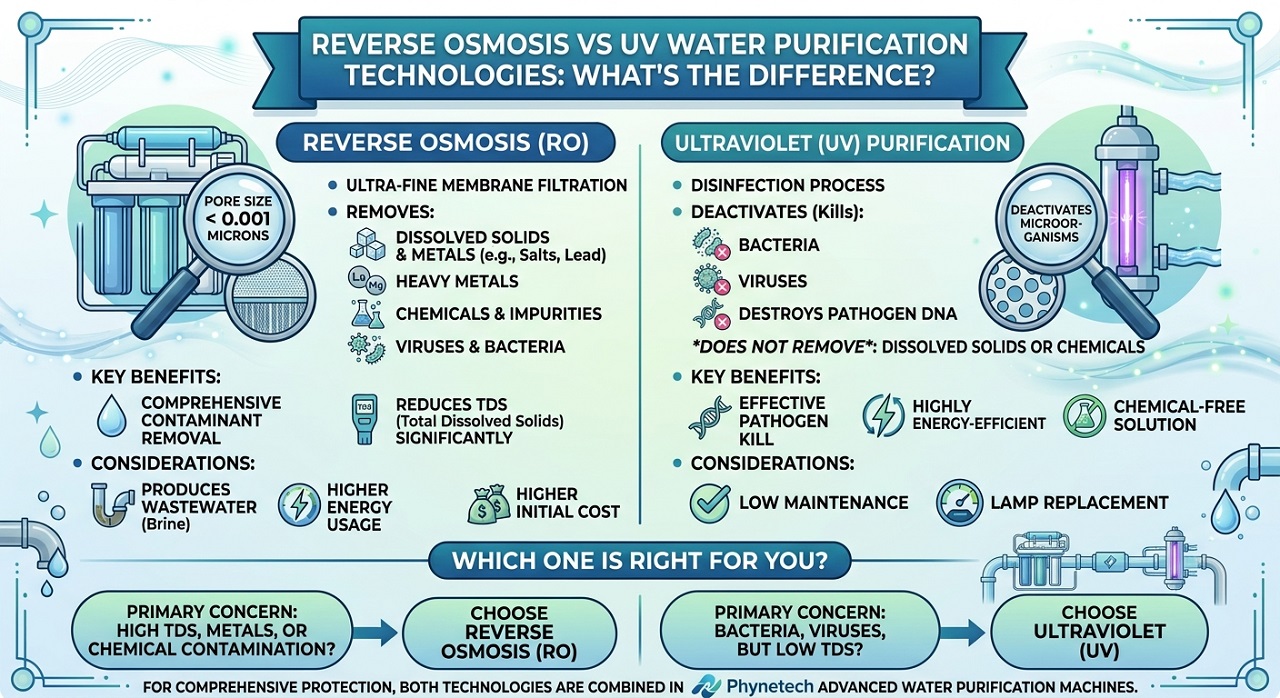
| Parameter | UV Purification | RO Purification |
| Technology type | Disinfection (light) | Filtration (membrane) |
| Removes dissolved salts | No | Yes (>95%) |
| Removes TDS | No | Yes (>95%) |
| Removes heavy metals | No | Yes |
| Removes bacteria/viruses | Yes (deactivates) | Yes (physically removes) |
| Removes chemical contaminants | No | Yes |
| Removes dead pathogens | No (remain suspended) | Yes (filtered out) |
| Preserves minerals | Yes | No (removes most) |
| Water wastage | Minimal | 20–50% of feed |
| Energy requirement | Low | High |
| Works with turbid water | No (needs clear water) | Yes (with pre-filtration) |
| Capital cost | Lower | Higher |
| Operating cost | Lower | Higher |
| Maintenance complexity | Simple | Complex |
| Ideal TDS range | Below 300 ppm | Above 300 ppm |
When to Choose UV Purification
UV is the right choice when:
- Your Water Has Low TDS but May Contain Microorganisms
If your water source is already treated municipal water with low dissolved solids but could be contaminated with bacteria or viruses, UV provides effective disinfection without removing beneficial minerals. - You Want to Preserve Natural Minerals
UV does not remove calcium, magnesium, or other beneficial minerals from water. For those who prefer water with its natural mineral content, UV is preferable to RO. - You Want a Chemical-Free Solution
UV disinfection does not add chemicals to the water, making it suitable for those concerned about chemical additives. - Energy Efficiency and Low Operating Costs Are Priorities
UV systems use less electricity and have lower operating costs than RO. - Your Water Is Clear and Free of Sediment
UV requires clear water to be effective. Turbidity and particles can shield microorganisms from UV light.
Typical UV Applications
- Municipal water with microbial contamination concerns
- Private wells with low TDS but biological contamination
- Pre-treatment in combined RO+UV systems
When to Choose RO Purification
 RO is the right choice when:
- Your Water Has High TDS or Dissolved Salts
RO is the only technology that effectively removes dissolved salts and reduces TDS. For borehole water in many parts of Kenya with TDS above 300 ppm, RO is essential. - You Need to Remove Heavy Metals or Fluoride
RO removes heavy metals like lead, mercury, and arsenic, as well as fluoride—contaminants that UV cannot address. - You Require High-Purity Water
For water bottling, pharmaceutical applications, or sensitive industrial processes, RO produces the high-purity water required. - Your Water Has Chemical Contamination
RO removes pesticides, industrial pollutants, and other chemical contaminants that UV cannot address. - You Want the Most Hygienic Water
RO not only kills bacteria but also filters out their dead bodies, making RO-purified water more hygienic than UV-purified water.
Typical RO Applications
- Borehole water with high TDS or high fluoride
- Water bottling and vending businesses
- Brackish water treatment
- Commercial and industrial applications
The Power of Combination: RO Water Purification + UV Water Purification
RO and UV are not mutually exclusive—they are complementary. In fact, combining both technologies provides the most comprehensive water purification available.
How They Work Together
| Stage | Technology | Function |
| 1 | Pre-filtration | Removes sediment and particles |
| 2 | RO membrane | Removes dissolved solids, heavy metals, chemicals |
| 3 | UV disinfection | Provides final biological safety barrier |
Why the Combination Is Superior
- RO removes what UV cannot: Dissolved solids, heavy metals, and chemical contaminants
- UV provides what RO cannot guarantee: Complete biological safety as a final barrier
- RO improves UV effectiveness: RO pre-treatment removes particles that can shield microorganisms from UV light, increasing UV effectiveness by approximately 6.8%
- Comprehensive protection: The combination addresses both chemical and biological contamination
This is why the Phynetech Reverse Osmosis Water Purifier includes UV disinfection as its final stage—delivering water that is both chemically pure and biologically safe.
Which Is Better for Kenyan Conditions?
The answer depends entirely on your feed water quality and application:
| Water Quality | Recommended Technology | Reason |
| TDS < 100 ppm, clear, possible bacteria | UV | Removes pathogens, preserves minerals, low cost |
| TDS 100–300 ppm (highland boreholes) | RO + UV (Low Hardness-Low Saline) | RO removes dissolved solids; UV ensures biological safety |
| TDS 300–1000 ppm (brackish) | RO + UV | Only RO can reduce TDS; UV adds biological protection |
| TDS > 1000 ppm | RO (high-pressure) + UV | Desalination required |
| High fluoride (Rift Valley) | RO + UV | RO removes fluoride; UV ensures biological safety |
| Turbid water with bacteria | RO + UV | RO removes particles and dissolved contaminants; UV adds biological safety |
Frequently Asked Questions About Reverse Osmosis vs UV Water Purification
- What is the main difference between RO and UV purification?
RO physically removes dissolved solids, heavy metals, and chemicals by filtration. UV uses light to deactivate bacteria and viruses but does not remove dissolved contaminants. - Which is better, RO or UV?
Neither is universally better—they solve different problems. RO is essential for high-TDS water with dissolved contaminants; UV is ideal for low-TDS water with microbial contamination. - Does UV remove bacteria and viruses?
UV is highly effective at deactivating bacteria, viruses, and other pathogens by destroying their DNA. - Does RO remove bacteria and viruses?
The RO membrane physically removes bacteria and viruses, and the system also filters out the dead bodies of pathogens. - Can UV be used alone for borehole water in Kenya?
Only if your borehole water has very low TDS (below 300 ppm) and no chemical contamination. Most Kenyan boreholes have elevated TDS, fluoride, or heavy metals that UV cannot remove. - Which system costs more to operate?
RO has significantly higher operating costs due to energy consumption, water wastage (20–50% of feed), and ongoing filter and membrane replacements. - Does UV produce wastewater?
UV systems do not produce a waste stream. RO systems produce a concentrate stream of 20–50% of feed water. - Which system is better for a water bottling business?
RO is essential. KEBS requires bottled water to have TDS below 10 mg/L—a standard only RO can reliably achieve. UV alone cannot reduce TDS. - Can RO and UV be used together?
Yes—and this is the most effective approach. RO removes dissolved contaminants, and UV provides a final biological safety barrier. - Does RO remove beneficial minerals?
RO removes most dissolved minerals, including beneficial calcium and magnesium. Some systems include a remineralization stage for drinking water applications.
Reverse Osmosis vs UV Water Purification- Conclusion
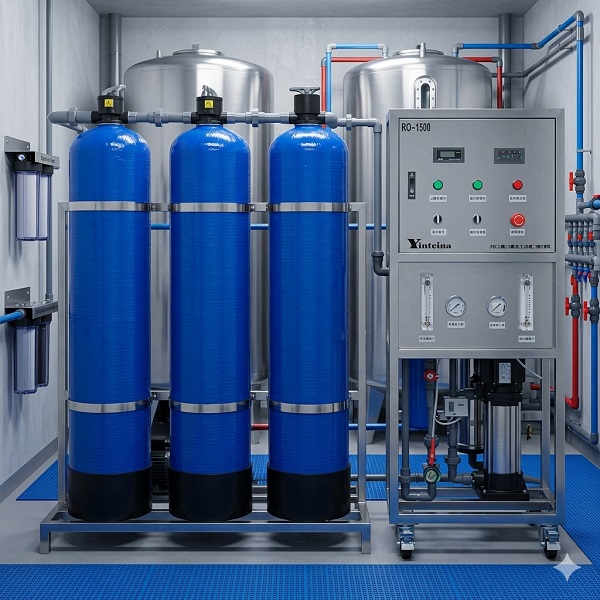 Reverse osmosis and ultraviolet purification are fundamentally different technologies that address distinct water quality challenges:
- UV is a disinfection method that uses light to deactivate bacteria and viruses. It preserves natural minerals, is energy-efficient, and produces no wastewater—but it cannot remove dissolved solids, heavy metals, or chemical contaminants.
- RO is a filtration method that physically removes up to 99% of all contaminants, including dissolved salts, heavy metals, and chemicals. It produces highly pure water but requires more energy, produces wastewater, and removes beneficial minerals.
For most Kenyan applications—particularly boreholes with TDS between 100 and 300 ppm—the ideal solution is an RO system with integrated UV disinfection. This combination ensures that water is free from both dissolved contaminants and biological pathogens, meeting the highest standards for drinking water quality.
The Phynetech Reverse Osmosis Water Purifier includes both technologies as standard, delivering comprehensive purification in a single, purpose-built system.
Explore the Phynetech Reverse Osmosis Water Purifiers
If you are looking for a commercial RO system with integrated UV disinfection—designed specifically for low-TDS water sources in Kenya—explore the full specifications, capacities, and pricing of the Phynetech Reverse Osmosis Water Purifiers.
For inquiries or to discuss your specific water quality:
- Phone/WhatsApp: +254 720 900 777 | 0717 777 112
- Email: phynetech@gmail.com
- Location: Ruiru Exit 11, Eastern Bypass, Kihunguro, Thika Road, Kenya
Still unsure which technology is right for you? Read The Role of RO Systems in Improving Safety of Drinking Water or our comparison of Reverse Osmosis vs Ultrafiltration for more information.

Discussion
Testimonials
"Talk of quality products Phynetech limited got u covered.Thanks for always being the best and not forgetting the customer service"
Becky Gichimu
Related Post
For more related Blog posts from Phynetech Limited Kenya