What Size RO System Do I Need? A Complete Capacity Guide
TL;DR Short Answer:
To determine what size reverse osmosis system you need, calculate your total daily water consumption in liters, add a 20–30% safety factor for peak demand and future growth, then divide by your planned daily operating hours to find the required liters-per-hour (L/h) capacity. For most Kenyan commercial applications, available capacities range from 250 L/h for small operations up to 3000 L/h for high-volume production. The Phynetech Reverse Osmosis Machines are available in different sizes: 250 L/h, 500 L/h, 1000 L/h, 1500 L/h, 2000 L/h, and 3000 L/h.
Introduction
 Choosing the right capacity for your reverse osmosis system is one of the most critical decisions you will make. Get it wrong, and you face one of two problems:
- Undersize your system: It runs continuously at maximum capacity, accelerating membrane fouling, increasing energy consumption, and shortening component life. You may run out of water during peak demand periods.
- Oversize your system: You waste capital on unnecessary equipment, pay higher energy bills than needed, and incur higher maintenance costs for a system you are not fully utilizing.
This guide walks you through a simple, step-by-step process to calculate the right RO system capacity for your specific needs—whether you are running a hotel, school, water bottling business, or residential complex in Kenya.
The Fundamental Sizing Formula for Determining the Right RO System to Invest in
The core calculation for sizing a commercial RO system is straightforward:
Required Capacity (L/h) = (Daily Water Demand × Safety Factor) ÷ Daily Operating Hours
Breaking Down the Formula
| Component | Explanation | Typical Value |
| Daily Water Demand | Total liters of purified water you need per day | Varies by application |
| Safety Factor | Buffer for peak demand and future growth | 1.2–1.3 (20–30%) |
| Daily Operating Hours | Hours per day the system will run | 8–12 hours for most commercial operations |
A Real-World Example

Let us say you run a small hotel with 20 rooms. Your daily purified water needs might look like this:
- Guest drinking water: 200 liters
- Kitchen and restaurant: 300 liters
- Laundry: 100 liters
- Total daily demand: 600 liters
Step 1: Apply the safety factor
600 liters × 1.25 = 750 liters (25% safety buffer)
Step 2: Divide by operating hours
If you plan to run the system 10 hours per day: 750 ÷ 10 = 75 L/h
Result: You would need a system rated for approximately 75 L/h.
However, because commercial RO systems in Kenya typically start at 250 L/h, you would step up to the next available capacity.
Available Capacities and Their Applications
The Phynetech Reverse Osmosis Machine is available in five capacities, each suited to different scales of operation:
| Capacity | Best For | Typical Daily Output (10-hour day) | Price (KSh) |
| 250 L/h | Small commercial applications, large households, small restaurants, offices, small schools | 2,000–2,500 liters | 230,000 |
| 500 L/h | Growing businesses, medium-scale operations, larger schools, small hotels, clinics | 4,000–5,000 liters | 330,000 |
| 1000 L/h | Water bottling plants, large institutions, hospitals, large hotels, apartment complexes | 8,000–10,000 liters | 600,000 |
| 1500 L/h | Water bottling plants, large institutions, hospitals, large hotels, apartment complexes | 12,000–15,000 liters | 850,000 |
| 2000 L/h | Heavy-duty, continuous high-volume production, large bottling plants, industrial applications | 16,000–20,000 liters | 1,000,000 |
Understanding Daily Output
The RO1000L, for example, can deliver 8,000 to 12,000 liters of purified water daily, depending on feed water quality and runtime. The exact output varies because factors like water temperature and feed TDS affect membrane performance—colder water is more viscous and can reduce permeate output.
Step-by-Step Capacity Selection Process
Step 1: Calculate Your Total Daily Water Demand
List all the ways you use purified water and estimate daily consumption in liters:
| Use Case | Typical Consumption |
| Drinking water (per person) | 2–3 liters/day |
| Kitchen/cooking | 50–200 liters/day (varies by scale) |
| Restaurant/bottling production | Depends on output volume |
| Laundry (commercial) | 100–500 liters/day |
| Cleaning and sanitation | 50–200 liters/day |
| Industrial processes | Varies widely |
Step 2: Identify Peak Demand Periods
Do you have specific times when water demand spikes? For example:
- A hotel may need more water during morning checkout and evening meal services
- A bottling plant may run only during production shifts
- A school may need most water during break times
A system sized for average demand will fail during peak periods.
Step 3: Add a Safety Factor
Industry best practice recommends adding 20–30% overcapacity to handle:
- Peak demand spikes
- Filter degradation over time (output gradually decreases as membranes age)
- Future business growth
For production line applications, the rule of thumb is to multiply the line filling rate by 1.2 to 1.5 to allow for cleaning and maintenance downtime.
Step 4: Determine Your Operating Schedule
How many hours per day will the system run?
- Most commercial operations run systems 10–12 hours per day, allowing time for cleaning-in-place (CIP) and maintenance
- Some operations run 24/7, which allows for a smaller system (more hours = lower L/h requirement)
- The recovery rate (percentage of feed water converted to purified water) typically ranges from 50–75% for commercial systems
Step 5: Consider Your Feed Water Quality
Higher TDS feed water requires more energy and larger membranes to achieve the same output. Our RO Machines range from 100–300 ppm TDS for low saline water to TDS levels of 2,000 ppm to 15,000+ ppm. If your feed water has higher TDS, you may need a different system or additional pre-treatment.
Capacity Guide by Application
| Application | Recommended Capacity | Rationale |
| Small office (10-20 people) | 250 L/h | Covers drinking and kitchen needs |
| Small restaurant/cafe | 250–500 L/h | Depends on seating capacity and menu |
| School (100-300 students) | 500 L/h | Drinking water and kitchen |
| Small hotel (10-30 rooms) | 500 L/h | Guest drinking, kitchen, laundry |
| Medium hotel (30-60 rooms) | 1000 L/h | Higher guest and operational demand |
| Large hotel (60+ rooms) | 1000–2000 L/h | Continuous high-volume demand |
| Hospital/clinic | 1000–2000 L/h | Patient care, sterilization, kitchen |
| Water bottling (small) | 500–1000 L/h | Production capacity matters |
| Water bottling (medium) | 1000–2000 L/h | Higher output for commercial sales |
| Apartment complex (50+ units) | 1000 L/h | Centralized water supply |
| Industrial/manufacturing | 2000+ L/h | Process water requirements |
Common Sizing Mistakes to Avoid When Buying a Reverse Osmosis System for Your Needs
- Sizing for Average Demand Only
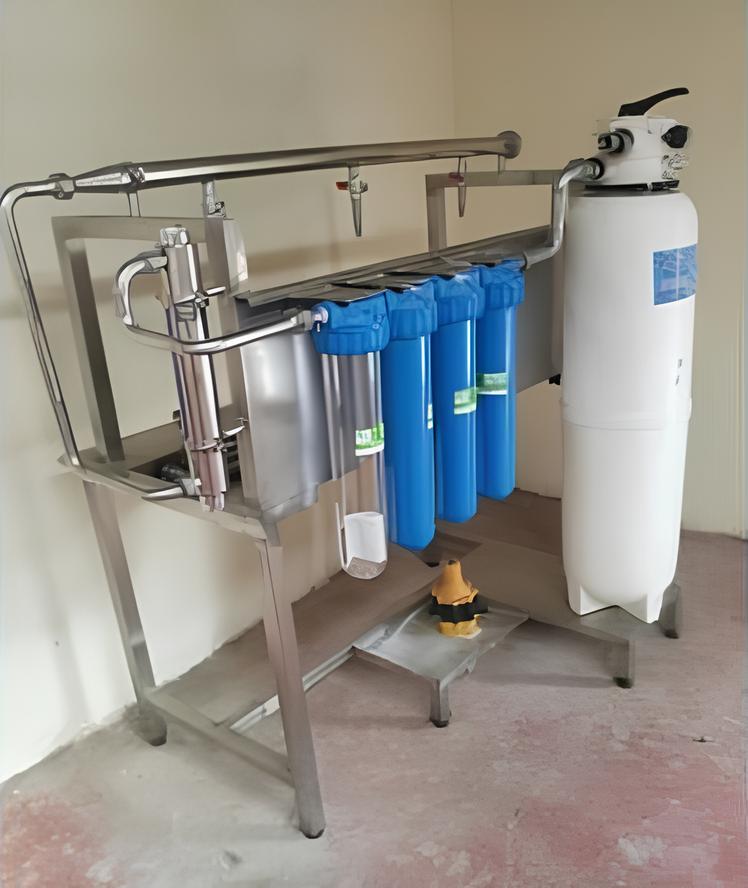
The mistake: Calculating based on typical daily usage without accounting for peak periods.
The consequence: The system cannot keep up during busy times, causing water shortages.
The fix: Always use peak demand (or average × 1.5) for your calculation.
- Forgetting About Recovery Rate
The mistake: Assuming the system’s L/h rating is the amount of feed water needed.
The consequence: You may not have enough feed water supply or may underestimate operating costs.
The fix: A system rated at 1000 L/h with 75% recovery needs approximately 1333 L/h of feed water.
- Ignoring Temperature Effects
The mistake: Not accounting for seasonal water temperature variations.
The consequence: Colder water reduces membrane output by 2–3% per degree Celsius below design temperature.
The fix: Size conservatively if your water source is cold (e.g., highland boreholes).
- No Room for Growth
The mistake: Sizing exactly for current needs.
The consequence: You need a new system within 1–2 years as your business grows.
The fix: Add 20–30% capacity for future expansion.
- Overlooking Storage
The mistake: Relying solely on the RO system’s production rate without storage.
The consequence: Any downtime (maintenance, repairs) means no water.
The fix: Install a storage tank so the system can produce water continuously and you have a buffer during peak demand.
Practical Example: Sizing for a Water Bottling Business
Let us walk through a complete example: 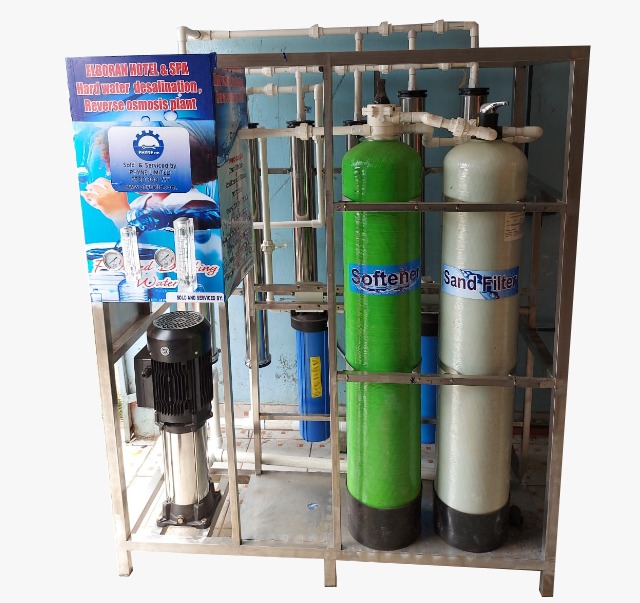
Scenario: You are starting a water bottling business in Kenya. You plan to bottle 500 liters of water per hour, operating 8 hours per day (4,000 liters/day).
Step 1: Base production need
500 L/h × 8 hours = 4,000 liters/day
Step 2: Apply production line safety factor
500 L/h × 1.3 = 650 L/h (allowing for cleaning and maintenance)
Step 3: Consider future growth
You expect to double production within 2 years.
650 L/h × 1.5 = 975 L/h
Step 4: Available capacity
The closest available capacity is 1000 L/h.
Result: The Phynetech RO1000L Reverse Osmosis Machine is the right choice for this application.
Phynetech RO Systems Capacity Range
Phynetech RO systems machines come in five capacity options, each engineered for water sources with TDS between 100 ppm and 300 ppm:
| Capacity | Price (KSh) | Ideal For |
| 250 L/h | 230,000 | Small commercial, large households |
| 500 L/h | 330,000 | Growing businesses, medium operations |
| 1000 L/h | 600,000 | Water bottling, large institutions |
| 1500 L/h | 850,000 | Water bottling, large institutions |
| 2000 L/h | 1,000,000 | High-volume production |
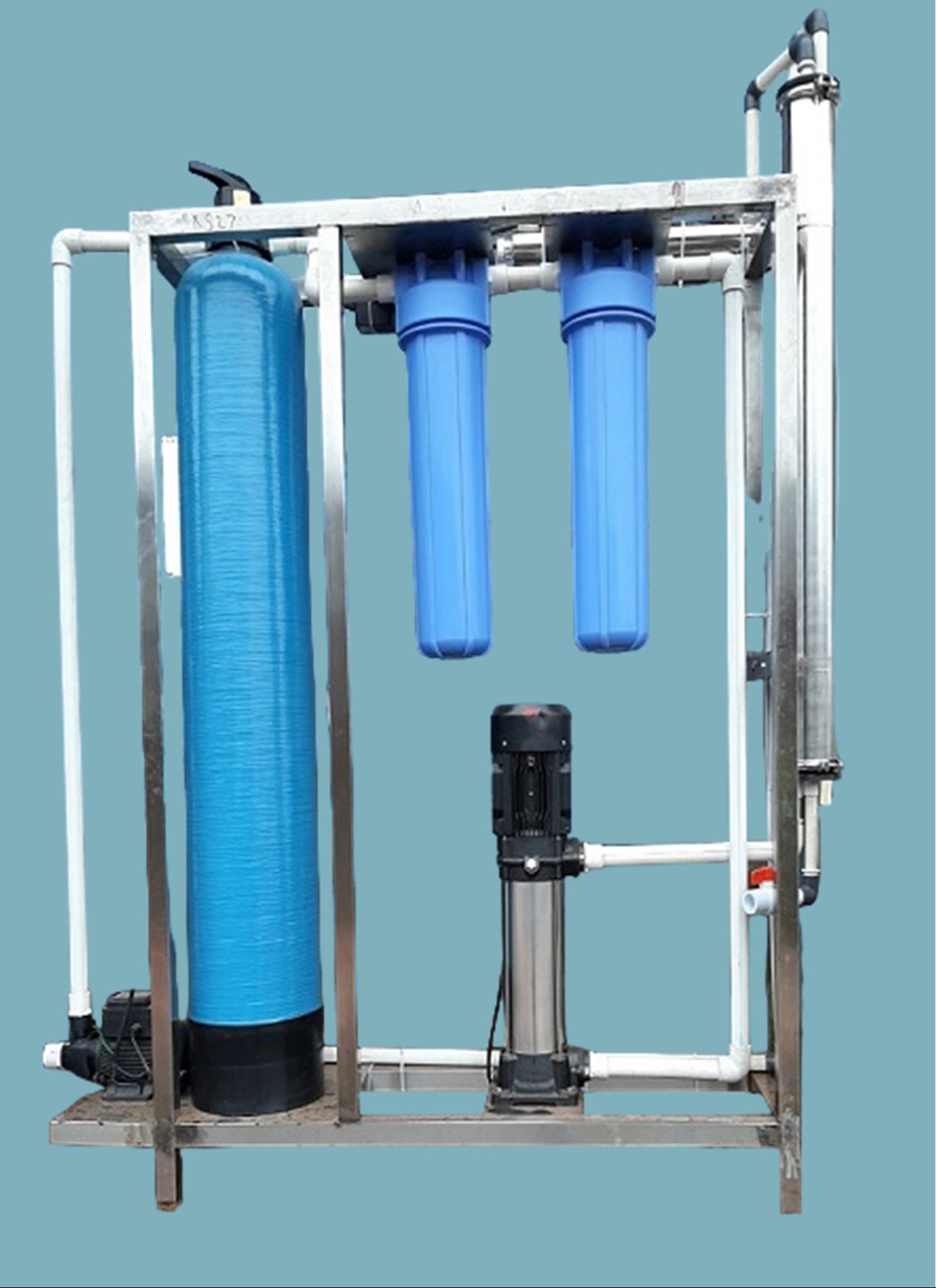
All models include the full five-stage treatment process: quartz sand media filtration, activated carbon filtration, micron cartridge filtration, RO membrane separation, and UV disinfection. Each system comes with a one-year warranty and free installation where applicable.
Frequently Asked Questions About What Size Reverse Osmosis System You Need
- What size RO system do I need for my home?
For residential use, systems are typically measured in liters per day (LPD) rather than L/h. Domestic systems range from 250–700 LPD. For commercial applications, L/h is the standard measure. - How much water does a 1000 L/h RO system produce daily?
Under typical conditions, the RO1000L can deliver 8,000 to 12,000 liters of purified water daily, depending on feed water quality and runtime. - What is a good safety factor for sizing?
Industry practice recommends a 2 to 1.3 safety factor(20–30% overcapacity) for most applications. For production lines with tight schedules, consider 1.5. - How does feed water TDS affect system sizing?
Higher TDS requires more membrane area, higher operating pressure, and more energy to achieve the same output. - Can I run my RO system 24 hours a day?
Yes, but commercial systems are typically designed for 10–12 hours of daily operation, allowing time for cleaning and maintenance. 24/7 operation requires more robust components and may increase maintenance frequency. - What happens if I undersize my RO system?
An undersized system runs continuously at maximum capacity, accelerating membrane fouling, increasing energy consumption, shortening component life, and potentially failing to meet peak demand. - What happens if I oversize my RO system?
An oversized system wastes capital, consumes more energy than necessary, and incurs higher maintenance costs for a system you are not fully utilizing. - How do I know which capacity is right for my water bottling business?
Calculate your bottling production rate (liters per hour) and multiply by 1.2–1.5 to allow for cleaning and maintenance downtime. For example, if you fill 500 L/h, you need an RO system producing at least 600–750 L/h.
What Size RO System Do I Need? – Conclusion

water purifiers for school
Sizing your RO system correctly is essential for reliable water supply, cost control, and long-term equipment life. The process is simple:
- Calculate your total daily water demand
- Add a 20–30% safety factor for peak demand and growth
- Divide by your planned daily operating hours
- Choose the nearest available capacity
Phynetech RO water purifying machines offer a scalable solution for applications ranging from small commercial operations to high-volume water bottling plants.
When in doubt, consult with a water treatment professional who can analyze your specific water quality and consumption patterns. Proper sizing today prevents costly problems tomorrow.
Explore Our Reverse Osmosis Water Purifying Machines
If you are ready to choose the right capacity for your borehole, business, or institution, explore the full specifications and pricing of the Phynetech Reverse Osmosis Water Purifying Machines.
For a personalized capacity consultation:
- Phone/WhatsApp: +254 720 900 777 | 0717 777 112
- Email: phynetech@gmail.com
- Location: Ruiru Exit 11, Eastern Bypass, Kihunguro, Thika Road, Kenya
Need help calculating your water demand? Read our Commercial RO System Buying Guide for Kenya for more detailed selection criteria.

Discussion
Testimonials
"Talk of quality products Phynetech limited got u covered.Thanks for always being the best and not forgetting the customer service"
Becky Gichimu
Related Post
For more related Blog posts from Phynetech Limited Kenya