Why Is It Important to Do a Water Analysis at an Accredited Lab Before Investing in a Commercial RO Machine?
Why Is It Important to Do a Water Analysis at an Accredited Lab Before Investing in a Commercial RO Machine?
TL;DR Short Answer:
Testing your source water at an accredited laboratory before buying a commercial reverse osmosis (RO) machine tells you exactly which pre-treatment stages your system needs. Without this data, contaminants such as calcium, iron, chlorine, or bacteria can foul or destroy an expensive membrane within weeks, and most manufacturers will not honour a warranty claim on a system installed without a baseline feedwater report.
Why Water Analysis Matters Before Any RO Investment
Water is central to health, hygiene, and every commercial process that depends on it. Regular water analysis, monitoring, and compliance with recognised quality standards protect consumers, staff, and equipment alike. For a business preparing to invest in a commercial RO system, this testing step is not optional paperwork. It is the engineering foundation the whole system is built on.
An RO membrane only does its job properly when the water reaching it has already been prepared for that specific membrane’s tolerances. A professional laboratory water analysis gives you the numbers needed to design that preparation correctly, rather than guessing based on what a neighbouring business installed.
What Happens When You Skip the Lab Test
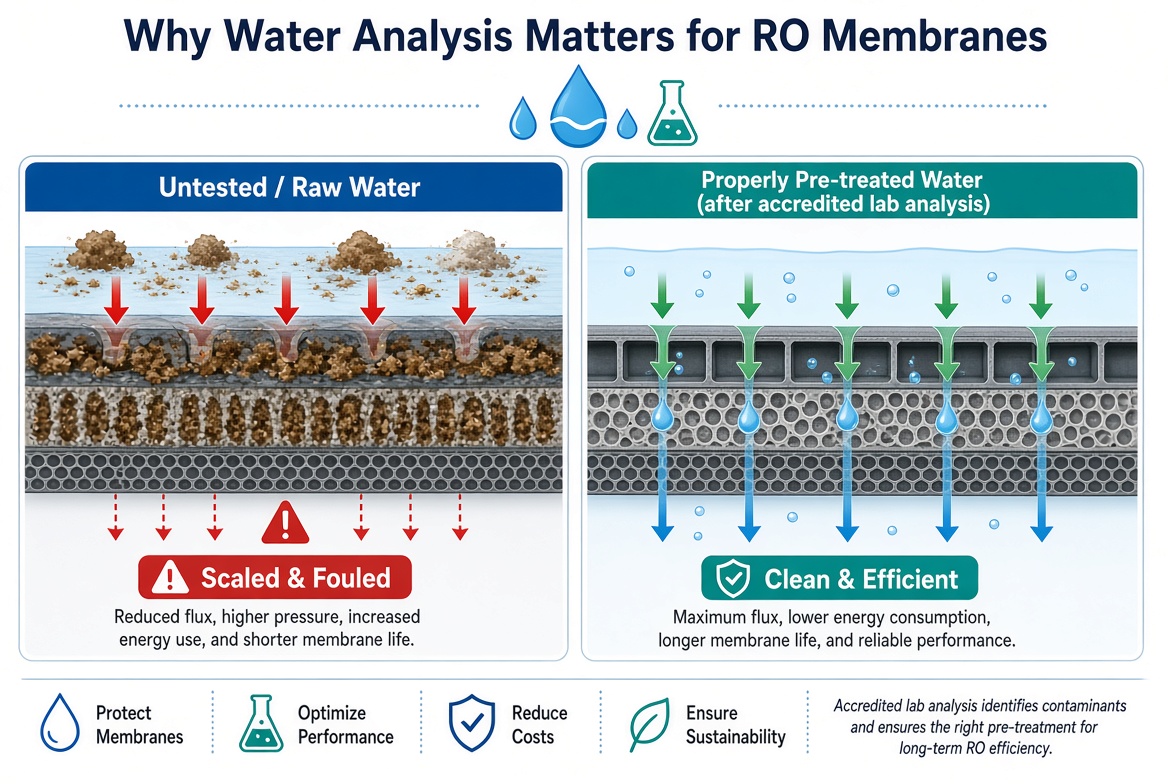
RO membranes are manufactured with extremely fine pores, fine enough to block dissolved salts, heavy metals, and microplastics while letting water molecules through. That same precision makes them highly sensitive to whatever arrives at the membrane surface unfiltered.
Because a spiral-wound RO membrane cannot be back-flushed or scoured the way conventional filters can, any material that accumulates on its surface stays there. Left unmanaged, this build-up shows up in several predictable ways:
- Scaling: dissolved minerals such as calcium and silica precipitate onto the membrane, cutting permeate flow and forcing pumps to work harder.
- Fouling: suspended solids, organic matter, and colloids physically block membrane pores and raise operating pressure.
- Biofouling: bacteria colonise the membrane surface and form a biofilm that is very difficult to remove once established.
- Chemical attack: unneutralised chlorine oxidises thin-film composite membranes, making them brittle and allowing salts to pass through untreated.
Any one of these failure modes can force early membrane replacement, and a system that is cleaned every three to six months is usually signalling a design fault rather than a maintenance one. A water analysis carried out before purchase is what allows a supplier to design around these risks from day one.
What an Accredited Water Analysis Actually Covers
A credible feedwater report goes well beyond a quick TDS meter reading. It should cover physical, chemical, and microbiological parameters, each of which points to a different pre-treatment decision.
| Test Category | What It Measures | Why It Matters for RO |
| Physical | Turbidity, colour, total dissolved solids (TDS), temperature | High turbidity clogs pre-filters and shortens membrane life |
| Chemical | Hardness (calcium, magnesium), iron, manganese, chlorine, pH, silica | Drives scaling, fouling, and premature membrane degradation |
| Trace / Heavy Metals | Arsenic, lead, fluoride, nitrates | Confirms whether RO is the right barrier and sizes downstream stages |
| Microbiological | Total coliforms, E. coli, general bacterial count | Determines the need for UV sterilisation or chemical disinfection |
Four Reasons an Accredited Lab Report Protects Your Investment
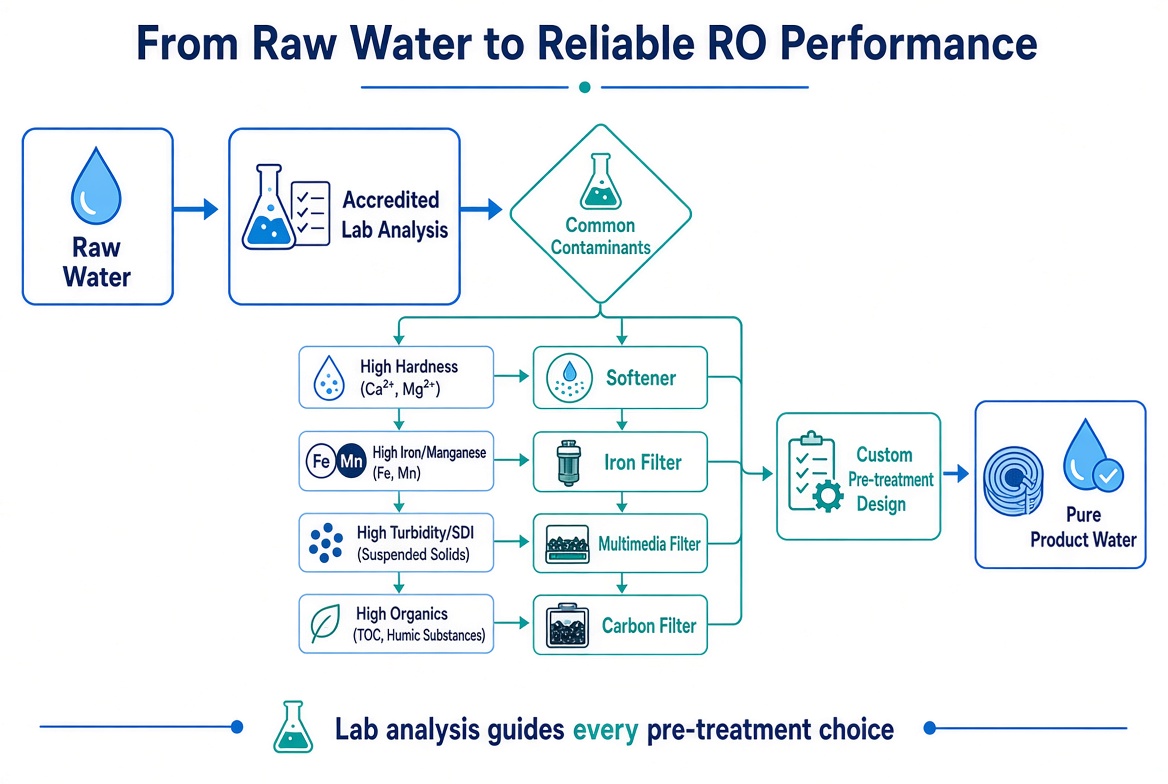
1. It Determines the Pre-Treatment Your System Actually Needs
If your source water carries high mineral content, hardness, or turbidity, an RO membrane fed directly with that water will scale or clog quickly. The lab report tells your supplier precisely which stages to add ahead of the RO membrane.
| Feedwater Issue | Recommended Pre-Treatment | Consequence If Skipped |
| Hard water (calcium, magnesium) | Water softener or antiscalant dosing | Scale build-up on the membrane surface |
| Free chlorine or chloramines | Activated carbon filtration | Oxidised, brittle thin-film membranes |
| Suspended solids, turbidity | Micro/ultrafiltration or multimedia filtration | Clogged pre-filters and reduced flow rates |
| Bacteria, coliforms | UV sterilisation or chemical disinfection | Biofilm growth and membrane biofouling |
| Iron and manganese | Oxidation and filtration, or iron-removal media | Membrane fouling and permanent staining |
2. It Uncovers Hidden Chemical and Microbiological Threats
A basic field test cannot detect trace metals such as arsenic, lead, or fluoride, which require laboratory-grade spectrometry to quantify accurately. These contaminants matter both for the safety of the finished water and for confirming that RO is the correct treatment barrier for your situation.
An accredited lab will also run microbiological tests for total coliforms and E. coli. If bacteria are present in the source water, the system design should include UV sterilisation or a chemical dosing stage to prevent biofouling before it starts, rather than reacting to it later.
3. It Lets Engineers Calculate Your Real Recovery Rate and Running Costs
Not every litre entering an RO system becomes usable product water. A portion is always rejected as concentrate, and the exact ratio depends on the dissolved solids and salts present in your feedwater. Knowing your baseline water chemistry allows engineers to calculate a realistic recovery rate, which in turn determines your daily water consumption, wastewater volume, and operating cost per litre produced.
Without this figure, a business risks underestimating its water bill or discovering, only after installation, that the system produces far less usable water per hour than expected.
4. It Protects Your Warranty and Prevents Costly Mis-Specification
Most commercial RO manufacturers will not honour a warranty claim on a system installed without a certified baseline feedwater analysis. Beyond warranty terms, a lab report ensures the unit you buy is correctly sized. Skipping this step often results in a system that is either badly undersized for demand or unnecessarily over-specified, wasting capital on capacity you do not need.
Water Testing Standards and Accredited Labs in Kenya
 In Kenya, potable water quality is governed by the Kenya Bureau of Standards (KEBS) under specifications including KS EAS 12 for bottled and packaged water and KS 459-1 for potable water generally, both of which draw on the World Health Organization’s Guidelines for Drinking-water Quality. The National Environment Management Authority (NEMA) separately regulates effluent and wastewater discharge under the Environmental Management and Coordination (Water Quality) Regulations.
KEBS operates ISO/IEC 17025 accredited laboratories covering chemical and microbiological water testing, and independent ISO 17025 accredited commercial labs offer similar testing across Nairobi and other major towns. Independent research on water sources across Nairobi has found significant non-compliance with KS EAS standards in some categories, which underlines why testing your specific source, rather than assuming it matches a general standard, is essential before committing to equipment.
Whichever laboratory you use, confirm that it holds current ISO/IEC 17025 accreditation for the specific parameters you need tested, and that it can issue a signed, dated report referencing the applicable Kenyan or WHO standard.
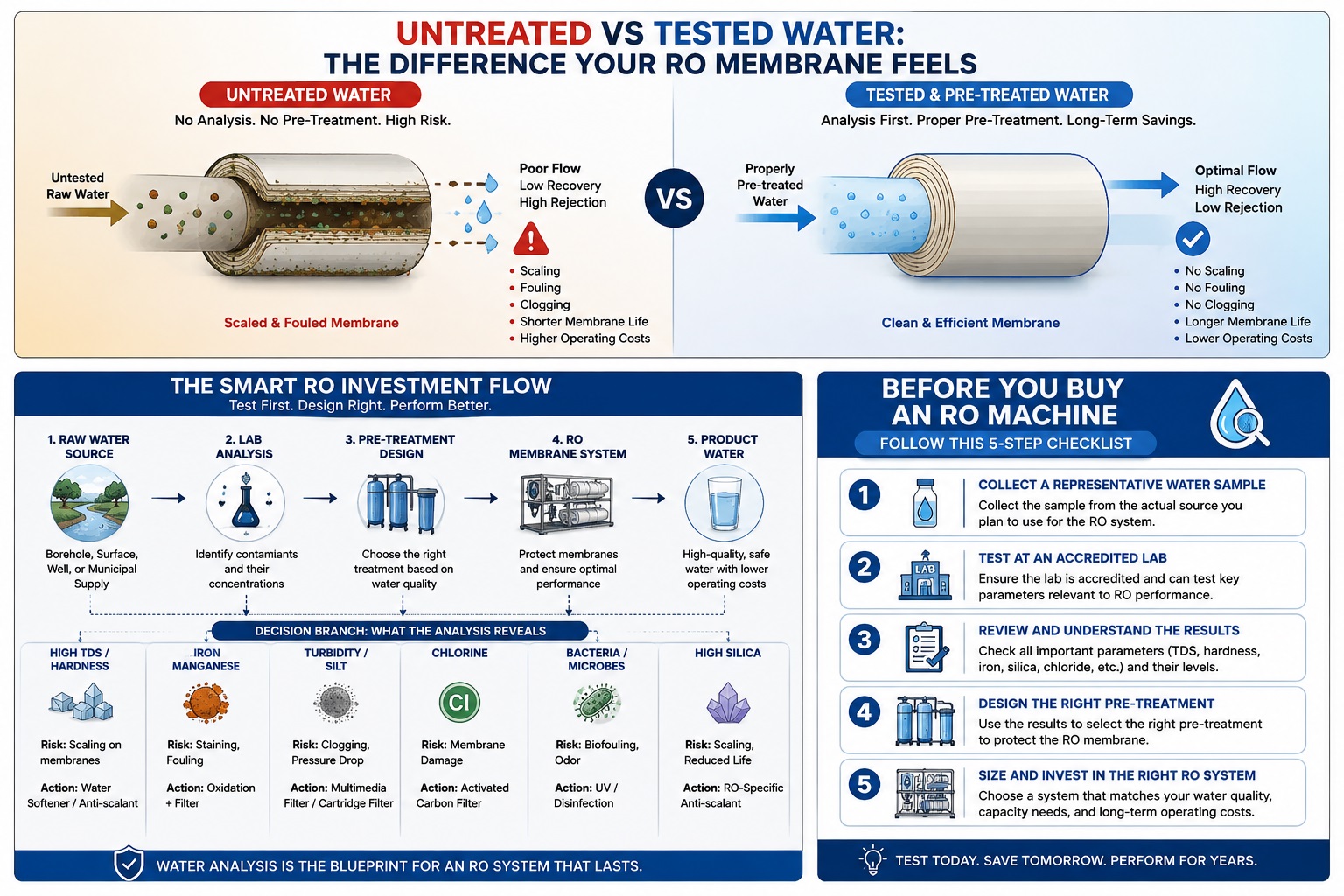
How to Get Your Water Tested Before Buying an RO System
- Identify your water source: borehole, municipal mains, river, or a blend, since each carries different contamination risks.
- Choose an ISO/IEC 17025 accredited laboratory that tests physical, chemical, and microbiological parameters, not just TDS.
- Collect a representative sample following the lab’s sampling protocol, ideally at the point where the RO system will draw water.
- Request a full written report with numerical results compared against KS EAS or WHO reference limits.
- Share the report with your RO supplier so the pre-treatment train and membrane specification are engineered around your actual water, not a generic assumption.
Key Takeaways
- An accredited water analysis is the starting point for correct RO system design, not an optional extra.
- Skipping lab testing risks membrane scaling, fouling, biofouling, and chemical degradation within weeks of installation.
- A full report covers physical, chemical, trace metal, and microbiological parameters.
- Lab data lets engineers calculate your real recovery rate and running costs before you commit capital.
- Most manufacturers require a certified feedwater report to honour the system warranty.
- In Kenya, KEBS and ISO/IEC 17025 accredited independent labs both offer certified water testing referenced against KS EAS and WHO standards.
Frequently Asked Questions
How much does a commercial water analysis cost in Kenya?
Costs vary by laboratory and by how many parameters are tested. A basic physical and chemical panel costs less than a full panel that also includes trace metals and microbiological testing. Contact an accredited lab directly for a current quotation based on your specific water source.
How long does the process take?
Basic physical and chemical results are often available within a few working days. Trace metal and microbiological analysis can take longer, since some tests require incubation periods or specialised equipment. Build this lead time into your project schedule before ordering equipment.
Can I skip lab testing if my water looks clean?
No. Many of the most damaging contaminants for RO membranes, including dissolved hardness minerals, chlorine, and trace heavy metals, are invisible to the naked eye and have no taste or odour at the concentrations that cause fouling. Visual clarity is not a reliable indicator of RO compatibility.
Do I need to retest after the RO system is installed?
Yes. Periodic retesting, typically once or twice a year, helps confirm the pre-treatment stages are still performing and that the membrane is rejecting contaminants as expected. Seasonal changes in a borehole or river source can also shift water chemistry over time.
Get Your Water Tested and Your RO System Right the First Time
At Phynetech Ltd, we help businesses across Kenya specify, supply, and install commercial reverse osmosis systems that are engineered around real, laboratory-verified feedwater data rather than guesswork. If you already have a water analysis report, our team can review it and recommend the correct pre-treatment and RO configuration for your site. If you have not yet tested your water, we can point you to an accredited laboratory and guide you through the process before any equipment is specified.
Get in touch to discuss your commercial water treatment project:
- Phone / WhatsApp: +254 720 900 777 | 0717 777 112
- Email: phynetech@gmail.com
- Location: Ruiru, Exit 11, immediately after Eastern Bypass, before Shell Petrol Station Kihunguro on Thika Road
References
- World Health Organization. Guidelines for Drinking-water Quality, Fourth Edition. World Health Organization (WHO). Accessed 3 July 2026. https://www.who.int/publications/i/item/9789241549950
- Kenya Bureau of Standards. KS EAS 12:2018 — Potable Water Specification. Kenya Bureau of Standards (KEBS). Accessed 3 July 2026. https://webstore.kebs.org/index.php?route=product/product&product_id=14909
- Kenya Bureau of Standards. About Testing — ISO/IEC 17025 Accredited Laboratories. Kenya Bureau of Standards (KEBS). Accessed 3 July 2026. https://kebs.org/about-testing/
- Polucon Group. Understanding KEBS and NEMA Water Quality Standards in Kenya. Polucon Group. Accessed 3 July 2026. https://polucon.com/blog/Understanding-KEBS-and-NEMA-Water-Quality-Standards-in-Kenya
- Tap Score / SimpleLab. What Is Reverse Osmosis (RO)?. Tap Score. Accessed 3 July 2026. https://mytapscore.com/blogs/tips-for-taps/what-is-reverse-osmosis
- EAI Water. The Role of Pre-Treatment in Maximizing Reverse Osmosis System Longevity and Efficiency. EAI Water. Accessed 3 July 2026. https://eaiwater.com/reverse-osmosis-pretreatment/
- Salt Separation Services. Using Water Testing to Monitor Reverse Osmosis Plant Efficiency and Lifespan. Salt Separation Services. Accessed 3 July 2026. https://saltsep.co.uk/using-water-testing-to-monitor-reverse-osmosis-plant-efficiency-and-lifespan
- Mugo, W.K. et al.. Water Quality Index of Distributed Potable Water Sources in Nairobi. Africa Journal of Physical Sciences, University of Nairobi. Accessed 3 July 2026. https://uonjournals.uonbi.ac.ke/ojs/index.php/ajps/article/download/1205/1586/

Discussion
Testimonials
"Talk of quality products Phynetech limited got u covered.Thanks for always being the best and not forgetting the customer service"
Becky Gichimu
Related Post
For more related Blog posts from Phynetech Limited Kenya